|
NEWxSFC - FINAL
Summary...01-APR-11 |
AVG SUMSQ |
AVG STP |
AVG Total Absolute |
AVG Absolute |
Mean RSQ |
|
||||||||||||||||||||
|
Previous Ranks |
Rank |
Forecaster |
Class |
Total STN 4casts |
Error ( " ) |
Error Z |
% MPRV over AVG |
Rank |
4cast ( " ) |
Error |
Error Z |
% MPRV over AVG |
Rank |
Error (") |
Error Z |
% MPRV over AVG |
Rank |
Error (") |
Error Z |
%MPRV over AVG |
Rank |
RSQ |
RSQ Z |
% MPRV over AVG |
Rank |
Forecaster |
|
1,1,1,1,1 |
1 |
donsutherland1 |
Senior |
154 |
255 |
-0.910 |
47% |
2 |
120.1 |
20.2 |
-0.451 |
36% |
5 |
52.1 |
-1.142 |
32% |
1 |
2.0 |
-1.134 |
31% |
1 |
63.8% |
1.092 |
45% |
3 |
donsutherland1 |
|
2,2,2,2,2 |
2 |
Donald Rosenfeld |
Senior |
148 |
217 |
-0.834 |
56% |
3 |
111.1 |
12.9 |
-0.574 |
49% |
6 |
49.8 |
-0.835 |
33% |
3 |
1.9 |
-0.868 |
32% |
3 |
64.1% |
1.009 |
37% |
3 |
Donald Rosenfeld |
|
6,3,3,3,3 |
3 |
Brad Yehl |
Rookie |
146 |
234 |
-0.702 |
45% |
4 |
101.5 |
23.9 |
-0.381 |
36% |
5 |
48.6 |
-0.697 |
25% |
5 |
2.0 |
-0.697 |
24% |
5 |
64.6% |
0.812 |
25% |
4 |
Brad Yehl |
|
5,4,4,4,4 |
4 |
ejbauers |
Intern |
147 |
313 |
-0.641 |
43% |
5 |
134.3 |
33.5 |
-0.089 |
12% |
7 |
59.4 |
-0.620 |
24% |
5 |
2.3 |
-0.631 |
24% |
5 |
66.8% |
0.735 |
31% |
3 |
ejbauers |
|
4,8,5,5,5 |
5 |
Mitchel Volk |
Senior |
148 |
380 |
-0.548 |
26% |
5 |
113.8 |
34.0 |
-0.297 |
20% |
6 |
63.0 |
-0.520 |
9% |
5 |
2.5 |
-0.565 |
11% |
5 |
50.2% |
0.208 |
15% |
6 |
Mitchel Volk |
|
10,9,8,7,7 |
6 |
TQ |
Senior |
148 |
290 |
-0.495 |
38% |
5 |
85.5 |
28.7 |
-0.099 |
13% |
7 |
51.2 |
-0.654 |
26% |
5 |
2.0 |
-0.673 |
24% |
5 |
57.3% |
0.422 |
16% |
6 |
TQ |
|
8,7,7,7,6 |
7 |
herb@maws |
Senior |
145 |
315 |
-0.417 |
32% |
6 |
99.5 |
33.5 |
-0.061 |
8% |
7 |
56.3 |
-0.340 |
15% |
6 |
2.4 |
-0.304 |
12% |
7 |
58.5% |
0.348 |
14% |
6 |
herb@maws |
|
9,10,9,9,9 |
8 |
MarkHofmann |
Journeyman |
157 |
728 |
0.794 |
-34% |
10 |
149.0 |
22.0 |
-0.042 |
-14% |
7 |
96.3 |
1.018 |
-27% |
10 |
3.6 |
1.024 |
-26% |
11 |
32.1% |
-0.743 |
-31% |
10 |
MarkHofmann |
|
12,12,11,12,10 |
9 |
Roger Smith |
Intern |
159 |
786 |
0.833 |
-32% |
11 |
151.9 |
54.2 |
0.484 |
-41% |
10 |
100.3 |
0.941 |
-21% |
11 |
3.8 |
0.834 |
-16% |
11 |
27.6% |
-1.357 |
-47% |
12 |
Roger Smith |
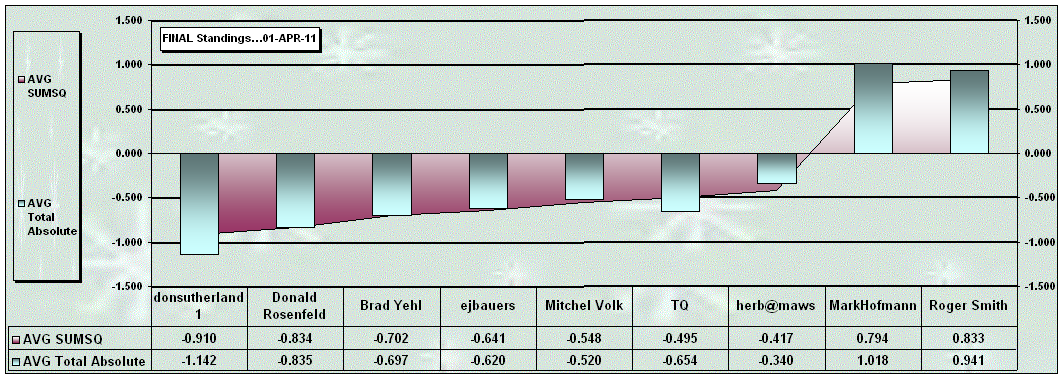
There were eight (8)
snowstorm-forecasting contests during the’10 / ’11 season …as of
01-APR-11. Under the ‘two-thirds’
rule…forecasters who entered at least six (6) forecasts are included in the
final standings.
A forecaster must enter at
least two-thirds of all Contests to qualify for ranking in the Interim and
final ‘End-of-Season’ standings. If a
forecaster has made more than enough forecasts to qualify for ranking…only the
lowest SUMSQ Z-scores necessary to qualify are used in the computing the
average. IOW…if you made nine forecasts…only your six best SUMSQ Z-scores
are used to evaluate your season-to-date performance. You can think of it
as dropping the worst quiz score before your final grade is
determined. The reason we have this rule is to 1) make it possible to
miss entering a forecast or two throughout the season and still be eligible for
Interim and ‘End-of Season’ ranking and 2) encourage forecasters to take on
difficult and/or late-season storms without fear about how a bad forecast
might degrade their overall 'season-to-date' performance score(s).
---
The mean normalized ‘SUMSQ
error’ is the Contest/s primary measure of forecaster performance.
This metric measures how well the forecaster/s expected snowfall
'distribution and magnitude' for _all_ forecast stations captured the
'distribution and magnitude' of _all_ observed snowfall amounts. A
forecaster with a lower average SUMSQ Z Score has made more skillful forecasts
than a forecaster with higher average SUMSQ Z Score.
The 'Storm Total
Precipitation error’ statistic is the absolute arithmetic difference
between a forecaster/s sum-total snowfall for all stations and the observed
sum-total snowfall. This metric…by
itself…is not a meaningful measure of skill…but can provide additional insight
of forecaster bias.
The 'Total Absolute
error' statistic is the average of your forecast errors regardless of
whether you over-forecast or under-forecast.
This metric measures the magnitude of your errors.
The 'Average Absolute
Error' is the forecaster/s ‘Total Absolute Error’ divided by the
number of stations where snow was forecast or observed.
The ‘RSQ error’
statistic is a measure of the how well the forecast captured the variability of
the observed snowfall. Combined with
the SUMSQ error statistic…RSQ provides added information about how strong the
forecaster/s ‘model’ performed.